A replication of the document:
From:
THE DEPARTMENT OF TRANSPORT
ROOM C14/18
2 MARSHAM STREET LONDON
SW1P 3EB
FAX: 071-276 0818
TELEX: 22221 DOEMAR-G
DIRECT LINE: 071-276 5349
SWITCHBOARD: 071-276-3000
GTN: 276
My Ref: GT 17/27/03
Your reference CIRCULAR ROADS 3/93
To:
The Chief Executive
County Councils )
Borough Councils ) in England
District Councils )
London Borough Councils
The Town Clerk, City of London
15 December 1993
Dear Sir/Madam
STREET NAME PLATES AND THE NUMBERING OF PREMISES
- This Circular supersedes Circular Roads 35/77 (which now lapses) but does not place any new burdens on local authorities. It updates the advice given in that Circular on design and installation of street name plates and reminds authorities of the need to maintain regular contact with the Royal Mail on new or revised naming and numbering proposals.
- Councils are asked to ensure that consultation takes place with the appropriate Royal Mail Postcode Centre at an early stage when considering new street naming and building numbering schemes. This is to allow the Postal Services adequate time to comment before agreement is given to a scheme and enables the Council to make changes to proposals in light of any representations received.
- It is important to both the Royal Mail and the Emergency Services to avoid giving streets similar names within the same locality. The close juxtaposition of similar names such as Park Road, Park Avenue and Park Gate Drive in the same area has proved to be a particular source of difficulty. A great variety of “999” calls are received each day and some callers can be vague in the details they give. Where names are duplicated it can be extremely difficult to pinpoint an exact location in order to enable an ambulance to attend in the time allowed.
- All authorities are reminded of the continuing need to maintain a good standard of street name plates and property numbering schemes and to improve existing standards where necessary. Both are essential for the efficient functioning of the Postal and Emergency Services as well as for the convenience and safety of the general public. It should be remembered that street names need to be legible by night as well as by day. Adherence to the standards set out in the attached Appendices can help to achieve the maximum advantage from expenditure undertaken.
- The illustration of particular designs in Appendix C is not intended to preclude the use of others which might be more suitable for a particular locality, but the authorities are strongly recommended to adopt approximately the same ratio of legend to background and to avoid unduly thin lettering in order to ensure legibility. Good colour contrast is also important and combinations which are likely to be a particular problem for those who are colour blind should be avoided. It is not suggested that existing plates of character and distinction should not be replaced. The aim should be to promote a good standard of design. This can be achieved by following the criteria set out in Appendix B.
- Authorities are requested to keep the street name plates and building numbering schemes in their area under review and to ensure they are of a good standard. Street name plates at junctions with main traffic routes should be given the first priority.
- The relevant powers for local authorities are contained in Sections 64 and 65 of the Towns Improvement Clauses Act 1847, Sections 17-19 of the Public Health Act 1925, and for London Boroughs Part II of the London Building Act (Amendments) Act 1939, as superseded by Section 43 of the London Government Act 1963 and paragraph 14 to Schedule 8 for the Local Government Act 1985.
Could you please bring this Circular to the attention of the Chief Surveyor or Engineer and the Chief Financial Officer to your authority.
Yours faithfully
R M Kimber
Assistant Secretary
Telephone enquiries about the content of this Circular should be made to Network Management & Driver Information (NMDI) Division on (071 - 276 5349). Enquiries about distribution should be made to NGAM Division (071 – 276 2730)
APPENDIX A - RECOMMENDATIONS FOR THE INSTALLATION OF STREET NAME PLATES
- Street name plates should be fixed as near as possible to street corners, so as to be easily readable by drivers as well as pedestrians. The name plate should normally be within 3 metres of the intersection of the kerb lines, but where this is not practicable the distance may be varied up to a maximum of 6 meters.
- Street name plates should be mounted so that the lower edge of the plate is approximately 1 metre above the ground at sites where they are unlikely to be obscured by pedestrians or vehicles and at approximately 2.5 metres where obscuration is a problem. They should never be lower than 0.6 metres or higher than 3.6 metres.
- Name plates should normally be fixed at each street corner. At minor crossroads, particularly in residential areas, one plate on each side of the street positioned on the offside of traffic emerging from the road may be sufficient, except where the road name changes or where it is thought that paragraph 8 would apply. At major crossroads, name plates will be necessary on both sides of each arm.
- At T-junctions a main street name plate should be placed directly opposite the traffic approaching from the side road.
- Where the street name changes at a point other than a cross-roads both names should be displayed at the point of change and many local authorities have found it useful to include arrows to indicate clearly to which parts of the street the names refer.
- On straight lengths of road without intersections name plates should be repeated at reasonable intervals with priority given to such places as bus and railway stations and opposite entrances to well frequented sites such as car parks.
- Where two streets branch off obliquely from a common junction with a third street, plates on fingerpost mountings can be useful, provided they do not obscure any traffic sign.
- Where it might reasonably be expected, for example at intervals on long straight lengths of road or at intersections or T-junctions, many local authorities have found it useful to incorporate on the name plate information indicating the street numbers on either side of the intersection.
- Whenever practical, street name plates should be mounted on walls, buildings or other boundary structures at the back edge of the footway. Post mounting or finger mounting should only be used where normal mounting does not make the plate conspicuous (e.g. where an important side road has a narrow entrance or in the exceptional circumstances mentioned in para 7 above, or where it will frequently be obscured by pedestrian movement and cannot be mounted at the 2.5 metre height).
- The name plates should be so fixed that there is a clear space of at least 300mm in every direction between them and any notices, advertisements or other printed or written matter. Where possible greater clearance should be provided. Nor should they be incorporated in other direction sign assemblies, but be kept distinct and mounted in as standardised a manner as possible. Care should be taken to keep the view of name plates free from obstruction by trees and other growth.
- Where possible, name plates should be fixed so that they will be illuminated by light from street lamps, especially at important junctions, provided they remain visible to vehicles on the main carriageway.
- Duplication of street names or nearly similar street names should be avoided within one postal area.
APPENDIX B - RECOMMENDATIONS FOR THE DESIGN OF STREET NAME PLATES
- Because street name plates are commonly viewed from an angle it is important that wide well-spaced lettering should be used.
- Capital lettering should be used to avoid confusion with traffic signs, which generally employ lowercase lettering.
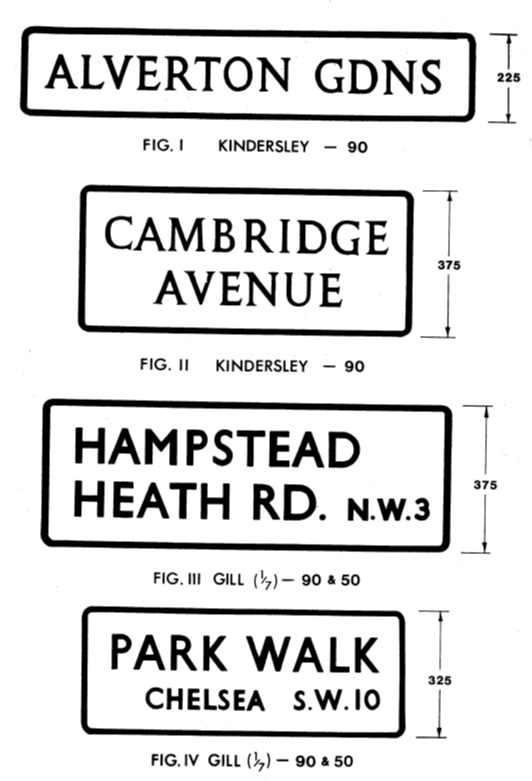
- Figures ( i ) – ( vi ) illustrate suggested alphabets and designs. It should be noted that the many serif alphabets do not perform well when used on reflectorised backgrounds. Authorities are recommended to employ “sans serif” lettering on reflectorised name plates. Figures ( iii ) and ( iv ) employ a "sans serif" Gill letter. Figure ( v ) – ( vi ) use the pre 1965 Revised Standard Transport Alphabet. Figure ( vii ) shows the Transport Heavy Alphabet which is in current use for black legends on traffic signs. The relationship of the stroke thickness to letter height is shown in brackets. (It should not be more than 1 : 7 and not less than 1 : 4, to ensure adequate legibility). Figure ( v) illustrates a street name plate with a “No Though Road” sign (diagram 816.1) in Traffic Signs Regulations General Directions 1981 (same number in the 1994 TSRGD). This sign may be used with any street name plate to indicate a no through road to vehicular traffic.
- A 100mm actual capital letter height of lettering is the recommended standard for both the Standard Transport and Transport Heavy Alphabets. With other alphabets with broader letter forms, 90mm may be used to reduce the length of the plate. Where fixing space is very restricted the design shown in Figure ( vi ) with either the Standard Transport or Transport Heavy Alphabets at 75mm capital letter height is preferable to using a 100mm alphabet with compressed letters and spacing. A 150mm letter height may be more appropriate on fast main roads.
- Normally street name plates should have black lettering on a white background with a black border, as this gives the best contrast. Where coloured legends or backgrounds are used, a contrast ratio of at least 7 : 1 is required. The use of colour combinations with low contrast, for example bronze or brown lettering on green backgrounds, will result in poor legibility, especially under low pressure sodium street lighting. The white background should be reflectorised wherever plates are likely to be viewed from vehicle headlamps.
- Only well known abbreviations should be used e.g. Ave., Cres., St., etc.
- When streets have been re-named, the old name crossed out but clearly legible should remain for at least 1-2 years and then removed.
- Only durable materials should be used for the construction of name plates and they should be maintained in a clean condition. Where a name plate is mounted on a specially provide post care should be taken to ensure that the appearance of the post and the back of the plate are as pleasing and as unobtrusive as possible. Aircraft grey No. 693 to BS 381c has been found an unobtrusive colour in most environments when erecting traffic signs and can be applied to street name posts. Black may also be used if preferred.
- Area colour coding by a background colour on the street name plate is not recommended. There is a loss of good contrast with many colour combinations. A coloured border may be a suitable alternative. Good contrast (a ratio of at least 7 : 1) is necessary if this is to be effective.
- The chief aim of letter spacing is to give good legibility having regard to the letter form used. Spacing should be sufficient to prevent letters having a jumbled appearance when viewed from an oblique angle. The apparent area between successive letters should be as uniform as possible and this is affected by the shape of individual letters. Vertical strokes found in B, D, E, etc are those which need to be furthest apart; curves in B, C, D, G, etc permit a slight decrease in spacing; right angled letters E, F, L, etc and slopping ones, A, K, V, etc can be closer still; some combinations such as LT, LY and VA can almost overlap.
- The minimum spacing between words should be some 40% - 50% of the letter height, dependent on the form of the terminal letters. The end spaces to the border should not be less than would apply if the border were the vertical stroke of an adjacent word, except that some reduction in end spaces may be satisfactory if the line consists of a single word or is the longest line of several. Top and bottom borders should not be less than 50% of the letter height, and spacing between the lines not less than 40% of the letter height.
- If district names are included on the name plate they should be shown in a smaller or reduced height of lettering. Figure ( iv ) gives an example.
APPENDIX C - RECOMMENDATIONS FOR THE DESIGN OF STREET NAME PLATES
- Unlike street name-plates there is no legal requirement for the numbers of premises when displayed to be conspicuous except where authorities have taken special powers in local Acts. Nevertheless, every effort should be made to persuade owners and tenants to ensure that properties are clearly numbered and to adopt the recommendations in paragraph 5 below.
- Main roads should be numbered so that when travelling away from the centre of town the odd numbers are on the left hand side and even numbers on the right. Succeeding numbers should be approximately opposite one another, even though this may mean the omission of certain numbers where frontages vary (Suffix letters may be used in such cases as an alternative). Side roads should be numbered ascending from the main road.
- The postal authorities (ie the local Royal Mail Postcode Centre) should be consulted on numbering pedestrian type layouts and other complex urban developments.
- In small groups of low rise flats, dwellings should be numbered within the ordinary street numbering system, but in tall blocks of flats each flat should be numbered so that the number indicates the floor level. The numbers of the flats contained in each block should also appear at the entrance to the block in a position clearly readable from the roadside.
- All houses, offices, business establishments and other premises should be numbered, preferably with a minimum size of numerals of 62.5mm, and their numbers should be displayed so as to be in a clearly readable position facing the road. Mounting may be on gates, gate posts, doors or walls as appropriate, but ensuring that there is a good colour contrast between the numerals and the background to which they are fixed.