21.10.1 Introduction
This guidance note intends to provide information on the definition, role and value of Traffic Sensitive Streets. It will also focus on how and why they should be reviewed and how to ensure they keep up to date.
The responsibility for reviewing Traffic Sensitive Streets lies with the Traffic Manager. However, the Authority Street Custodian should be involved in the review process.
21.10.2 What is a Traffic Sensitive Street?
Under section 64 of NRSWA a Street Authority may designate certain Streets (or parts of Streets) as Traffic-Sensitive.
It is a designation that allows highly trafficked Highways to be identified as requiring Works Promoters to give greater advanced warning of proposed works or activities.
Depending on circumstances, designation may apply to the carriageway only, to a Footway or pedestrian area only, or to any part of a length of Street. Designations may only apply to certain times of day, days of the week, or days of the year.
21.10.3 Why designate a Street as Traffic Sensitive?
This designation highlights that works or activities in these situations are likely to be particularly disruptive to other road users, but it does not necessarily prevent occupation during traffic-sensitive times.
Once a designation is made it applies to all works and activities taking place in the Street.
21.10.4 Criteria to designate a Street as Traffic Sensitive
A Street Authority may designate certain Streets (or parts of Streets) as "traffic-sensitive" of one of the two following ways:
- Agreement with Statutory Undertakers known to have apparatus in the Street concerned.
- One or more of the following criteria is met:
- the Street is one on which at any time the Street Authority estimate traffic flow to be greater than 500 vehicles per hour per lane of carriageway, excluding bus or Cycle Lanes;
- the Street is a single carriageway two-way road, the carriageway of which is less than 6.5 metres wide, having a total traffic flow of not less than 600 vehicles per hour;
- the Street falls within a congestion charges area;
- traffic flow contains more than 25% heavy commercial vehicles;
- the Street carries in both directions more than eight buses per hour;
- the Street is designated for pre-salting by the Street Authority as part of its programme of winter maintenance;
- the Street is within 100 metres of a critical signalised junction, gyratory or roundabout system;
- the Street, or that part of a Street, that has a pedestrian flow rate at any time of at least 1300 persons per hour per metre width of Footway;
- the Street is on a tourist route or within an area where international, national, or significant major local events take place.
21.10.5 How to review a Street Authorities Traffic Sensitive Streets
With many Streets being designated as a Traffic Sensitive Street following their introduction as part of NRSWA in 1991, it is vital that Street Authorities undertake a periodic review of all Traffic Sensitive Streets to ensure it includes current day street use.
The Streetworks Manager, Authority Street Custodian and Traffic Manager should all be roles that are involved in the process.
To undertake a traffic sensitive review there are two distinct requirements:
- Identification of Traffic Sensitive Streets (Section 20.6 below)
- Consultation with stakeholders (Section 20.7 below)
21.10.6 Identification of Traffic Sensitive Streets
There are no hard and set rules on how to identify Traffic Sensitive Streets and each Street Authority may have their own preferred process but the following recommends an approach that could be undertaken which has been utilised by some Street Authorities already.
i. Identification of winter maintenance routes
It is likely the Street Authority will have designated Streets that are sensitive to traffic for salting during the winter, therefore this will give a good initial indication of all the Streets that could be designated as a Traffic Sensitive Street. Streets designated for salting is one of the criteria that can be used to designate a Street as a Traffic Sensitive Street. To ensure confidence in the decision it is advised that the Street Authority also checks against other criteria, such as the following.
ii. Utilise Traffic Counts
Obtaining traffic counts will enable a Street Authority to identify if Streets meet the following criteria:
- The Street is one on which at any time the Street Authority estimate traffic flow to be greater than 500 vehicles per hour per lane of carriageway, excluding bus or cycle lanes.
- The Street is a single carriageway two-way road, the carriageway of which is less than 6.5 metres wide, having a total traffic flow of not less than 600 vehicles per hour.
- Traffic flow contains more than 25% heavy commercial vehicles.
- The Street carries in both directions more than eight buses per hour.
Ideally traffic count information collected by the Street Authority will be held against USRNs. If not, any coordinate information can be used to identify USRNs within the closest vicinity which will enable a Street Authority to identify Streets that are highly trafficked.
The DfT hold national traffic count information for England and Wales for Motorways and A Roads which can be utilised if local counts are not held. See - www.dft.gov.uk/traffic-counts
iii. Traffic Signals
Usually obtainable from the Street Authorities, traffic management centre. Streets can be identified as traffic sensitive if they fall within 100 metres of a critical signalised junction as per the following criteria:
- The Street is within 100 metres of a critical signalised junction, gyratory or roundabout system.
The advised process would be to plot these signals using coordinate information to identify the closest USRN, this would then enable criteria against certain Streets to be built up but may also identify Streets that have previously not been identified as traffic sensitive.
iv. Pedestrian Flow & Tourist Routes
To ensure completeness, it is recommended that Street Authorities consider any critical Streets where tourism routes, national, international, or significant major local events exist which may not necessarily be gritted or have the necessary usual flow.
If pedestrian counts are available Street Authorities may wish to review Footways and Footpaths that have a lot of, for example, footfall traffic on certain days and include these in any review, as fundamentally, works on these will still cause disruption to the public.
v. Traffic Sensitive times review
Utilising traffic count data is a positive process to understand the network, especially to indicate Streets that are only traffic sensitive for limited periods of time, for example, Streets subject to a “school run”. Ensuring a true reflection of traffic sensitivity gives users full visibility of when they will be able to undertake works or activities causing the minimum of disruption.
21.10.7 Consultation
Following the identification of Traffic Sensitive Streets, the Street Authority must:
- Consult for a period of not less than one month, over which any objections may be made.
- Identify the criteria that is met for each proposed designation of traffic sensitivity.
It is also advised that where possible the Street Authority should provide a visual aid of the designated Traffic Sensitive Streets to make sure they are easily identifiable.
i. Who needs to be consulted?
It is recommended the following stakeholders would need to be consulted with:
- Every undertaker known to the Street Authority to be working in their area.
- Every undertaker that has given the Street Authority notice of its intention to start working in their area.
- Every other Street Authority for which the proposed Traffic Sensitive Street designation is related.
- Transport for London, where the Street is in Greater London.
- The Chief Officer of Police, Chief Executive of Fire and Rescue Authority, the Chief Executive of the National Health Service Ambulance Trust.
- Where appropriate, the Passenger Transport Executives and other transport authorities, such as light rail operators.
- Any person who has submitted a written request to be given notice of a proposed Traffic Sensitive Street designation. This may include other Street Authorities, such as, Highways Agencies and Network Rail.
- Consultation notifications should be sent occupiers of any property that front the proposed Traffic Sensitive Street designation.
ii. What should be provided to stakeholders?
At the very least a table with the following information is recommended:
- USRN – Identifier for the Street used in street works coordination.
- Street Name – Name or description of the Street.
- Town – Geographical location of the Street.
- Criteria met – Traffic Sensitive criteria met.
- Rationale – Rationale used that has met the criteria.
An example table is provided below:
1234567
Smith Street
Rochester
B, D, F
10 Buses per hour, 888 vehicles per hour
In addition, any maps or spatial files that could be provided would ensure that stakeholders can be consulted effectively.
iii. What happens following consultation?
No objections - If the Street Authority does not receive any objections to the proposed Traffic Sensitive Street designation within the specified period, or if all objections have been withdrawn, the Street Authority may assign the designation.
Outstanding objections - the Street Authority should give them careful consideration. It may then assign the designation, with or without modifications, or decide not to do so. The Street Authority should carefully consider the arguments for and against the proposed Traffic Sensitive Street designation and should act reasonably and responsibly in coming to their decision.
21.10.9 Updating the Local Street Gazetteer
Once the consultation is complete and a full traffic sensitive network is complete. It now needs to be created in the LSG, once submitted and published in the NSG, this can then be identified for street works coordination purposes by all NSG Users.
The recommend approach to updating the LSG is in bulk, either via the Street Authorities software or by contacting GeoPlace with regards to amending CSV files. For further help or advice on how to do this contact, GeoPlace - [email protected].
If Streets are only traffic sensitive between certain times this must be referred to in any Records created.
21.10.10 Maintaining Traffic Sensitive Streets
It is recommended that the Street Authority reviews their Traffic Sensitive Street designations periodically. GeoPlace recommend that this is undertaken every 2-3 years to ensure currency. This may not need to be a full review but should include Traffic Sensitive Streets that have experienced change in traffic flows or newly built classified Streets.
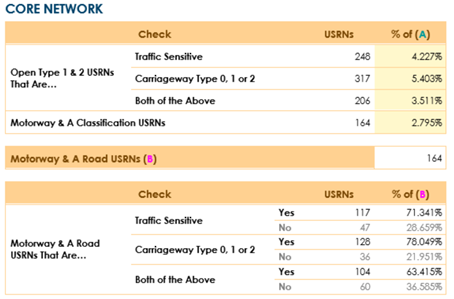
GeoPlace also provide the following health checks to monitor Streets that are classified as, Street Authority maintained Motorway or A Roads, or have a reinstatement carriageway type of 0, 1 or 2 that are not designated as a Traffic Sensitive Street.
- SP605 - Streets identified as Highway Authority maintained as Motorway, A or B Roads that are not Traffic Sensitive
- SP606 - Streets identified with a Reinstatement Carriageway type of 0, 1 or 2 that are not Traffic Sensitive
Alternatively, the Additional Street Data (ASD) review provided monthly by GeoPlace to each Street Authority provides a core network review to monitor any changes:
21.10.11 Continued Consultation
It is important to remember that any additions to traffic sensitivity still require consultation. The recommended approach would be to email all identified stakeholders on a case by case basis.