8.4.1
Determine the extent of the PRoW that needs to be recorded in the LSG.
8.4.2
Ensure each section of the PRoW is represented by either a type 1 Street or a type 2 Street.
8.4.3
If the PRoW requires a new section, for example along a Footpath or across a field, then create this as a type 2 Street with an appropriate description and a new ESU for this section.
8.4.4
If a new type 2 Street is included for a PRoW, it may be necessary to split the ESUs along the Highway to ensure the new PRoW coincides with the type 2 Street at each ESU for the PRoW. Also:
- Create a type 3 Street for the PRoW.
- Cross-reference each type 3 Street to the ESUs of the type 1 and type 2 Streets.
8.4.5
If the PRoW follows junction to junction sections of the Highway already in the NSG, for example surfaced urban paths, attach the type 3 Street to the appropriate ESUs of the type 1 and type 2 Streets.
8.4.6 Worked Example.
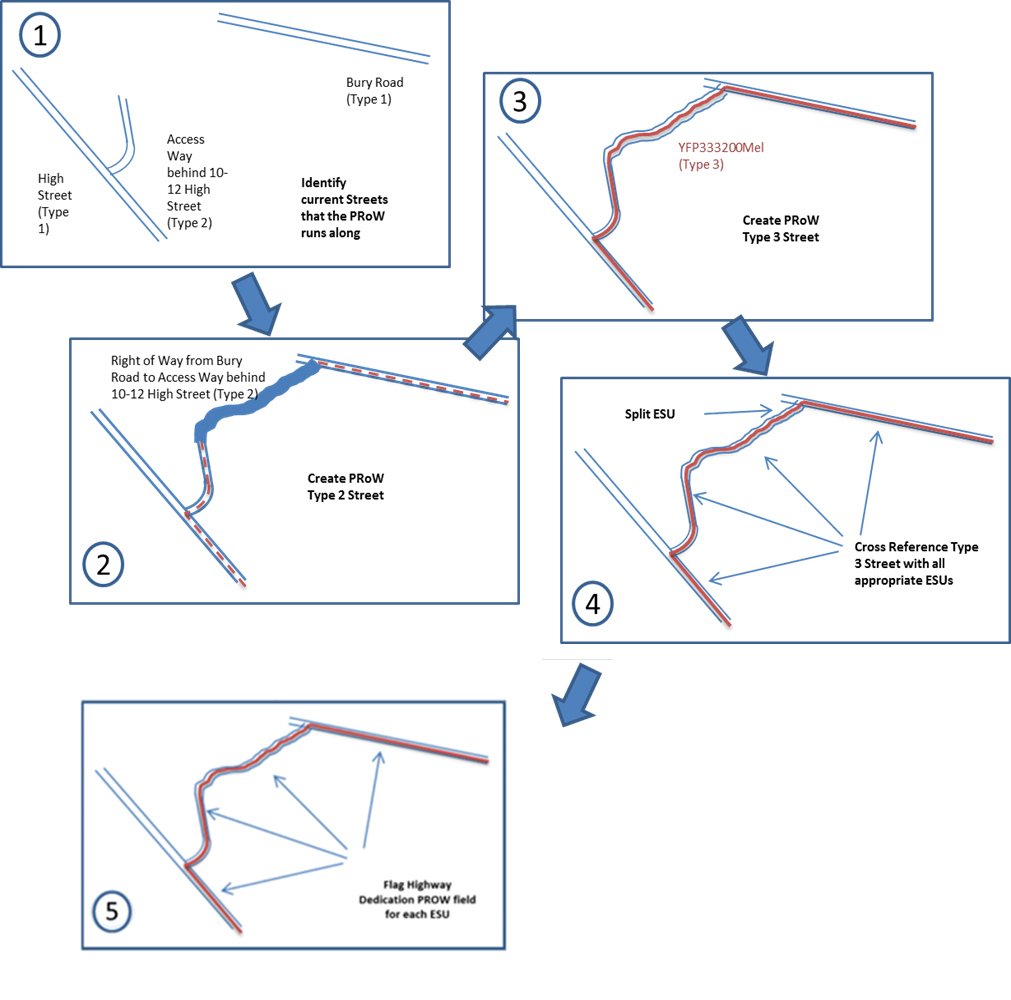
In Figure 24, a PRoW passes along a main Street, down an access way, then further extends across a field before re-joining a Highway. In this case undertake the following things:
- Identify Streets that are currently in the NSG which are coincident with a PRoW. See diagram 1.
- Create new Streets for the sections of the PRoW not currently represented. See diagram 2.
- Create a type 3 Street for the PRoW. See diagram 3.
- Split ESUs where necessary and cross-reference the type 3 Street to the appropriate ESUs of the type 1 Street or type 2 Street. See diagram 4.
- The type 17 Highway Dedication Record PRoW indicator Field – HD_PROW, must be set to “1”, see Section 9.4.6 and diagram 5 below.
Figure 24 - Example PRoW
If a PRoW is part of a larger route such as a national path, then create a type 4 Street and cross-reference the type 4 Street ESUs to the ESUs that identify the type 1 or type 2 Street. These type 4 Streets must be continuous until the end of the route, stopping only at LHA boundaries. An example of this is a Coastal Path which consists of several PRoWs.