11.3.2.1
A separate set of ESUs must be recorded for each direction of travel of a dual carriageway. Each officially named (type 1) Street or officially described (type 2) Street section of carriageway must be recorded into the LSG.
11.3.2.2
If a section of dual carriageway has one official name, all ESUs for both directions of travel must be cross-referenced to the USRN for the type 1 Street.
11.3.2.3
If a section of dual carriageway is not officially named, it must be described. One type 2 Street must be recorded for the section of dual carriageway.
11.3.2.4
The Street description is not dependent on direction of travel and only one description must be created for each unnamed section of carriageway.
11.3.2.5
The description of a dual carriageway does not consider the numbering of properties on the Street. Figure 40 represents a typical section of dual carriageway and entry / exit slips.
Figure 40 - Dual carriageway entry and exit
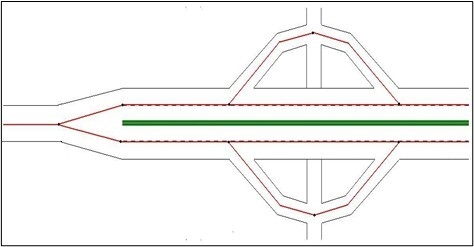
Note: The green line represents the central reservation.
11.3.2.6
Where a Level Crossing is the responsibility of Network Rail, the section of Highway for which they are responsible must be a separate ESU. Network Rail must submit the necessary Special Designation Record for the Level Crossing to the NSG. See Appendix H.
11.3.2.7
Where a Level Crossing is the responsibility of an operator that does not have any Highways responsibilities, so that the crossing is publicly maintainable highway, then it is not necessary to create a separate ESU. This is likely to be the case for most preserved railways.