10.2.3.1
If a type 1 Street is not continuous, to decide whether one USRN or two are required, consider the following things:
- If the two parts of the Street share the same town and locality, then enter the two sections as a Street, with one USRN, with a break in the middle.
- If the Street was a single USRN without the break, then enter a single USRN with ESUs either side of the break.
- If the Street was two USRNs without the break, then enter two USRNs, one each side of the break.
10.2.3.2
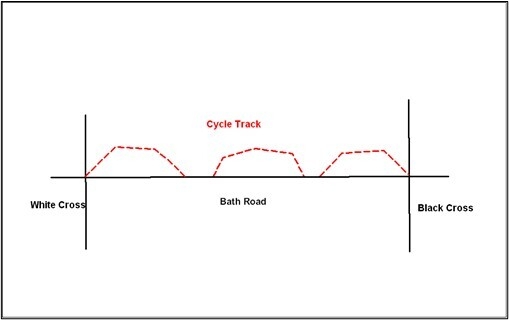
Type 2 Streets must be continuous. If a type 2 Street is split, the Streets must have two or more USRNs with a description for each section. However, if the descriptions are confusing, for example because of a lack of obvious landmarks, it is more practical to have a single USRN. For an example, see Figure 26.
Figure 26 – Non-continuous Streets
10.2.3.3
In Figure 26, this can be three Streets:
- “Cycle Track from White Cross to Bath Road.”
- “Cycle Track from Bath Road to Bath Road.”
- “Cycle Track from Bath Road to Black Cross.”
10.2.3.4
In Figure 26, the lack of landmarks to mark the start and end of each section of the Cycle Track leads to a confusing repetition of “Bath Road”. It is better to have a single Street called “Cycle Track from White Cross to Black Cross” because this is less confusing.
10.2.3.5
A type 3 Street can be non-continuous as A and B road numbering can be interrupted by a Street of higher priority number. However, it must not be used to refer to an area of streets and must remain continuous wherever possible.
10.2.3.6
A type 4 Street can be non-continuous, for example if there are gaps in a long-distance trail.